The Marks He Kept
Easter, Easter 2026, Meditation, Rev. Vijayesh Lal
Easter Meditation
By Rev. Vijayesh Lal
Nobody recognised him at first.
That is the detail the resurrection accounts keep returning to, and we keep glossing over. Mary stood outside the tomb weeping and thought he was the gardener. Two disciples walked with him for hours on the road to Emmaus and did not know who he was until he broke the bread. The disciples on the lake shore saw a figure on the beach and did not recognise him until the nets filled.
The resurrection did not look like what anyone expected.
And I think that is the first thing Easter Sunday asks us to sit with. Not the triumphant announcement. Not the empty tomb as spectacle. But the quieter, stranger, more unsettling truth that God’s greatest act in human history arrived without the kind of vindication that would have satisfied those watching.
He simply appeared. In a garden. On a road. On a shoreline. Among ordinary things. To people who were not looking for him because they had stopped believing there was anything left to look for.
That is still how he comes.
Not always in the moment we expected. Not always with the timing that would have made the most sense to us. But he comes. And when he does, something in us knows. The way Mary knew when he said her name. The way the disciples knew when the nets filled. The way the two on the road knew when the bread was broken and their hearts, they said, had been burning all along without their realising it.
Now I want to say something about the resurrection that we do not say often enough.
When Jesus appeared to his disciples that first Easter evening, he showed them what Friday had left on him. He did not arrive unmarked, with all evidence of the cross removed, as though it had not happened. He arrived glorified and still scarred. Both at the same time. The resurrection did not erase what happened on Good Friday. It passed through it and came out the other side, carrying the marks of it permanently, into eternity.
Thomas was invited to place his hand into the mark of the spear. Not simply to verify that the resurrection had happened. But to understand what kind of resurrection it was.
It was not an escape from suffering. It was the redemption of it.
That distinction is everything. Especially this Easter.
Because there are followers of Jesus this morning who are not waking up to flowers and celebrations. They are waking up in displacement camps, in houses that are no longer safe, in places where they buried someone they loved under conditions that should never have been asked of them. There are believers in active war zones who have lost everything and are still holding on to the name of Christ with both hands. There are Christians in places where faith costs something real, something daily, something that does not end when the Easter service does.
For those people, a resurrection that simply erased suffering would not be good news. It would mean their Friday did not count. That what was taken from them did not matter. That God noted their pain briefly and then moved on.
But that is not the resurrection we have.
The resurrection we have is one where the marks are kept. Where the one who went through the worst of it came back still bearing what it cost, permanently, in a glorified body that will never forget Friday. Where the risen Lord is not a distant victor who has left suffering behind, but the scarred one who walks into locked rooms, into displacement, into the places where hope has run out, and says peace be with you.
He does not say it was not that bad. He does not say it is over now. He says peace. From the other side of the marks. From beyond the worst Friday imaginable. With the full authority of someone who has been there and come through.
That is the word for the suffering church this Easter. Your pain is not hidden from him. It is not outside his experience. It is not a problem he is observing from a distance. He has been in that place. He came through it. And the same power that brought him through is the power that holds you. Your Friday is not forgotten in his Sunday. In some way that exceeds our full understanding, it is carried in him. Permanently. Into glory.
And for those of us whose Easter is comfortable, whose Friday has been more liturgical than literal, the marks in his hands say something equally important.
Do not reduce this day to celebration alone. Let the marks remind you that the resurrection was not cheap. That it cost everything. And that the comfortable Christian and the suffering Christian stand at the same empty tomb, on exactly equal ground, held by exactly the same risen Lord.
There is no hierarchy at the empty tomb. No one gets a stronger claim on it based on how much they have suffered or how little. It belongs to all with the same force and the same grace.
He is risen.
Not as a slogan. Not as a greeting to be exchanged and forgotten by Monday morning. As the fixed point around which everything in the Christian life turns. The thing that makes Friday bearable and Saturday survivable and every subsequent day liveable.
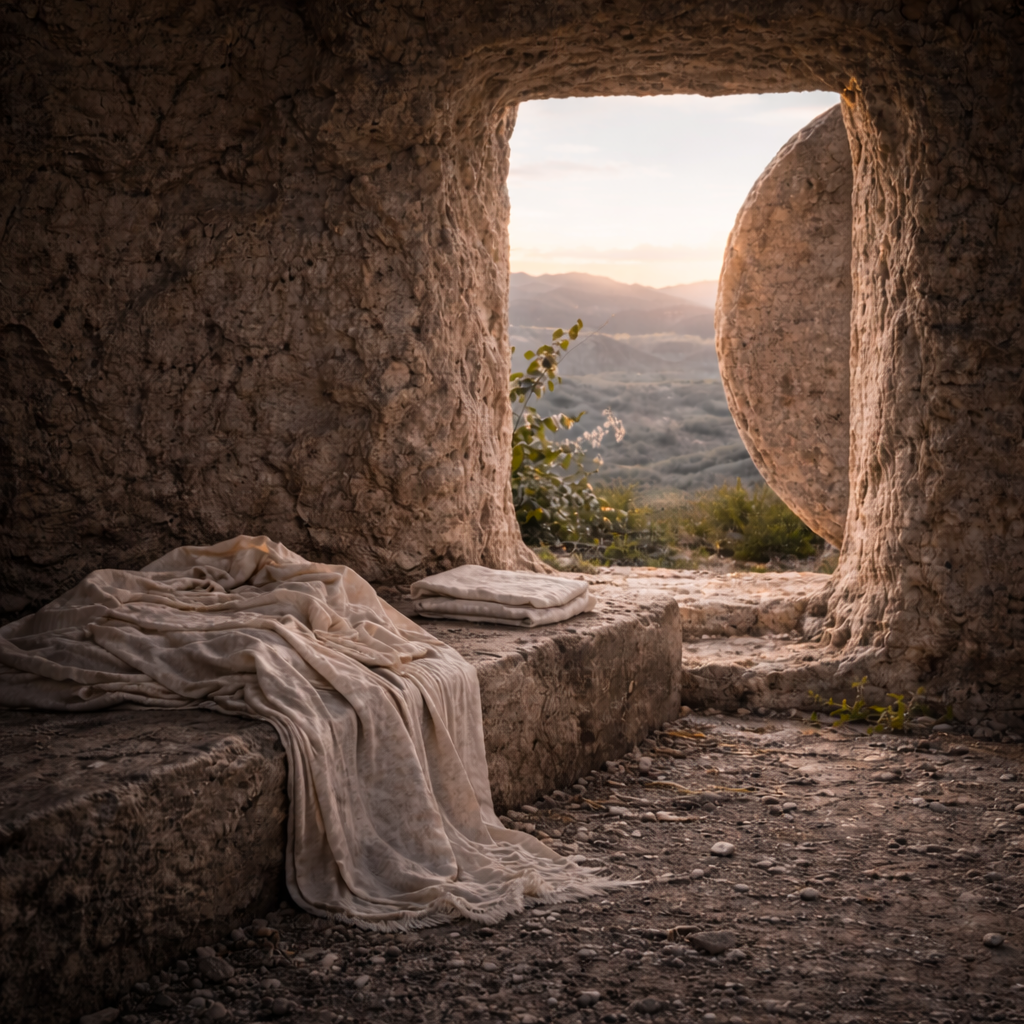
He is risen. The marks are real. The tomb is empty.
And he is still appearing. In gardens. On roads. On shorelines. Among ordinary things. To people who have stopped expecting him.
Watch for him today.